

Key Points
- You do not need to accept a label before asking for help.
- Look at control, consequences, and changes over time.
- This reflection guide is not a diagnostic test or a scoring tool.
- A professional assessment considers medications, mental health, and withdrawal risk.
At a Glance
| Area to reflect on | Useful information to bring |
|---|---|
| Control | What you planned versus what happened. |
| Time and priorities | Activities or responsibilities displaced by use. |
| Consequences | Specific health, relationship, or safety concerns. |
| Physical changes | Symptoms when use is delayed or reduced. |
| Goals | What you want daily life to look like. |
It is possible to be worried about your drinking or drug use while still showing up for work, paying bills, and caring about the people around you. Problems do not always arrive as one dramatic event. They may appear as a growing collection of exceptions: another morning lost, another rule changed, or another explanation you would rather not give.
The question “Am I addicted?” can feel too large to answer alone. A more useful starting point is to examine what has changed and whether your choices still feel like choices. The eleven patterns below offer a way to organize that reflection. They are not a diagnosis, a severity score, or a substitute for a conversation with a qualified healthcare professional.
1. Your Actual Use Repeatedly Exceeds Your Plan
Perhaps you intend to have one drink and regularly continue, or buy enough of a product for several days and run out much sooner. The important issue is the repeated difference between intention and behavior. Record what you planned and what happened without turning the exercise into self-punishment. Concrete examples give an assessor more useful information than a broad description such as “I overdo it sometimes.”
Context matters. A single occasion does not explain your entire relationship with a substance. Look for a pattern that has become harder to interrupt, particularly when you have already changed your plans to accommodate it. Ask whether the limits you set still influence what happens, or whether they mainly provide reassurance before the same outcome repeats.
2. Cutting Back Has Become a Repeated Unfinished Project
You may have tried switching brands, setting rules, avoiding certain people, or stopping for a short period. Those attempts can reveal motivation and useful information, even when they do not last. Notice what gets in the way: physical discomfort, cravings, stress, easy access, or uncertainty about how to handle a social situation without using.
Do not use an abrupt stop as a test of willpower when withdrawal could be dangerous. Heavy alcohol use and regular benzodiazepine use deserve medical advice before a major change. The FDA’s benzodiazepine warning explains why sudden discontinuation can carry serious risks. Difficulty changing your pattern is a reason to seek support, not proof that you have failed morally.
3. Obtaining, Using, or Recovering Takes More of the Day
Time can be a revealing measure. Think about travel to purchase a product, waiting for an order, arranging a private opportunity to use, or recovering afterward. Include the mental time spent checking supplies and adjusting plans. Someone may use a substance for a relatively brief period while the surrounding routine occupies much of their attention.
Compare a typical week now with a period before these routines developed. Which activities disappeared? Which responsibilities are repeatedly postponed? This comparison does not require a perfect memory or a detailed diary. A few specific changes can show why treatment might be helpful even when the amount used seems smaller than someone else's.
4. Cravings Interrupt What You Want to Do
A craving may feel like a strong urge, persistent bargaining, or difficulty focusing until you can use. Describe what sets it off and how you respond. An argument, an evening alone, pain, or passing a familiar place may become part of the pattern. Noticing a trigger is different from blaming it for every choice.
You can also notice when urges are easier to manage. Supportive company, an appointment, a different route home, or a structured activity may offer clues for a treatment plan. Bring both difficult and manageable moments to an assessment. The aim is to understand what support works for you rather than to document only the worst parts of the week.
5. Responsibilities Keep Slipping
Missed deadlines, repeated lateness, unpaid obligations, and forgotten plans can become visible consequences. Sometimes another person quietly takes over, making the impact less obvious. Ask what would happen if that person stopped covering the gap. This is not an invitation to remove support abruptly; it is a way to see the full cost of the current arrangement.
Substance use is not the only possible cause of these problems. Depression, sleep disorders, pain, and other conditions can also affect functioning. An assessment should consider that broader picture. You do not need to prove that one substance explains everything before discussing a pattern that is making everyday life less stable.
6. Relationships Repeatedly Return to the Same Conflict
Someone close to you may raise concerns about how you behave while using, what you spend, or whether they can rely on you. Consider the specific observation instead of judging the entire conversation by its tone. A poorly handled argument can still contain information worth examining when everyone is calmer.
At the same time, another person's accusation is not a diagnosis. Look for repeated consequences and your own experience of control. A counselor can help separate substance-related problems from other relationship difficulties. If a relationship is unsafe or coercive, seeking help should include attention to your safety rather than assuming that every demand from a partner is reasonable.
7. Activities You Value Are Becoming Less Important
You may stop attending a class, avoid friends who do not use, or abandon hobbies because they interfere with access to a substance. The change can happen gradually enough that it begins to feel normal. Ask which parts of your life you miss and which plans you have stopped making altogether.
These answers can become positive treatment goals. Returning to a weekly walk with a friend, finishing a course, or being present for a child's event may feel more concrete than a distant promise to “change everything.” Recovery planning can connect those goals to manageable actions rather than treating abstinence or reduced risk as an isolated task.
8. Use Continues in Situations Where Safety Is Compromised
Driving while impaired, operating equipment, supervising children while heavily sedated, or using an unfamiliar tablet alone can create immediate risk. You do not need a diagnosis to change a dangerous arrangement. Arrange safe transportation and seek help when you cannot reliably protect yourself or someone in your care.
If a person cannot be awakened or has slow breathing, treat it as a medical emergency. Call 911 and give naloxone for a suspected opioid overdose if available. A period without a previous emergency does not guarantee the next exposure will be safe, especially when ingredients are uncertain or several sedating substances are involved.
9. You Keep Using Despite a Health Concern
Perhaps a clinician has raised a concern, symptoms repeatedly worsen after use, or you suspect a connection but avoid discussing it. Write down the symptom and timing rather than diagnosing yourself. Honest information about alcohol, prescriptions, nonprescription products, and supplements helps a healthcare professional evaluate possible causes and interactions.
Be clear about why you use the substance as well. Someone trying to manage panic or chronic pain needs those needs addressed. A treatment conversation should make room for both the harm you are experiencing and the relief you have been seeking. Ignoring either side can leave an important part of the situation unexplored.
10. The Same Amount No Longer Feels the Same
Tolerance refers to a change in response with repeated exposure. It can lead people to increase use, but it is not a reliable measure of safety. Products can vary, and feeling less affected does not establish that driving, mixing substances, or taking more is safe. Describe changes to a clinician rather than using them to calculate an unsupervised increase.
Tolerance and physical dependence can also occur during appropriate prescribed treatment. Their presence alone does not establish addiction. Do not stop medication because a checklist makes you anxious. Ask the prescriber to review your concerns, the benefits of treatment, and whether the current plan still fits your health needs.
11. Feeling Unwell Without the Substance Influences Your Decisions
If delaying use brings discomfort, you may begin taking a substance mainly to feel normal. That experience warrants assessment. Explain which symptoms appear and what else you are taking. A professional can consider withdrawal, recurrence of an underlying condition, and other explanations without assuming they are interchangeable.
The NIAAA’s description of alcohol use disorder illustrates how clinicians evaluate multiple symptoms in context over time. This article intentionally does not turn your answers into a diagnosis. Even one serious safety concern can justify getting help, while several concerns may require careful assessment rather than a self-assigned label.
Turn Your Observations Into a Useful Appointment
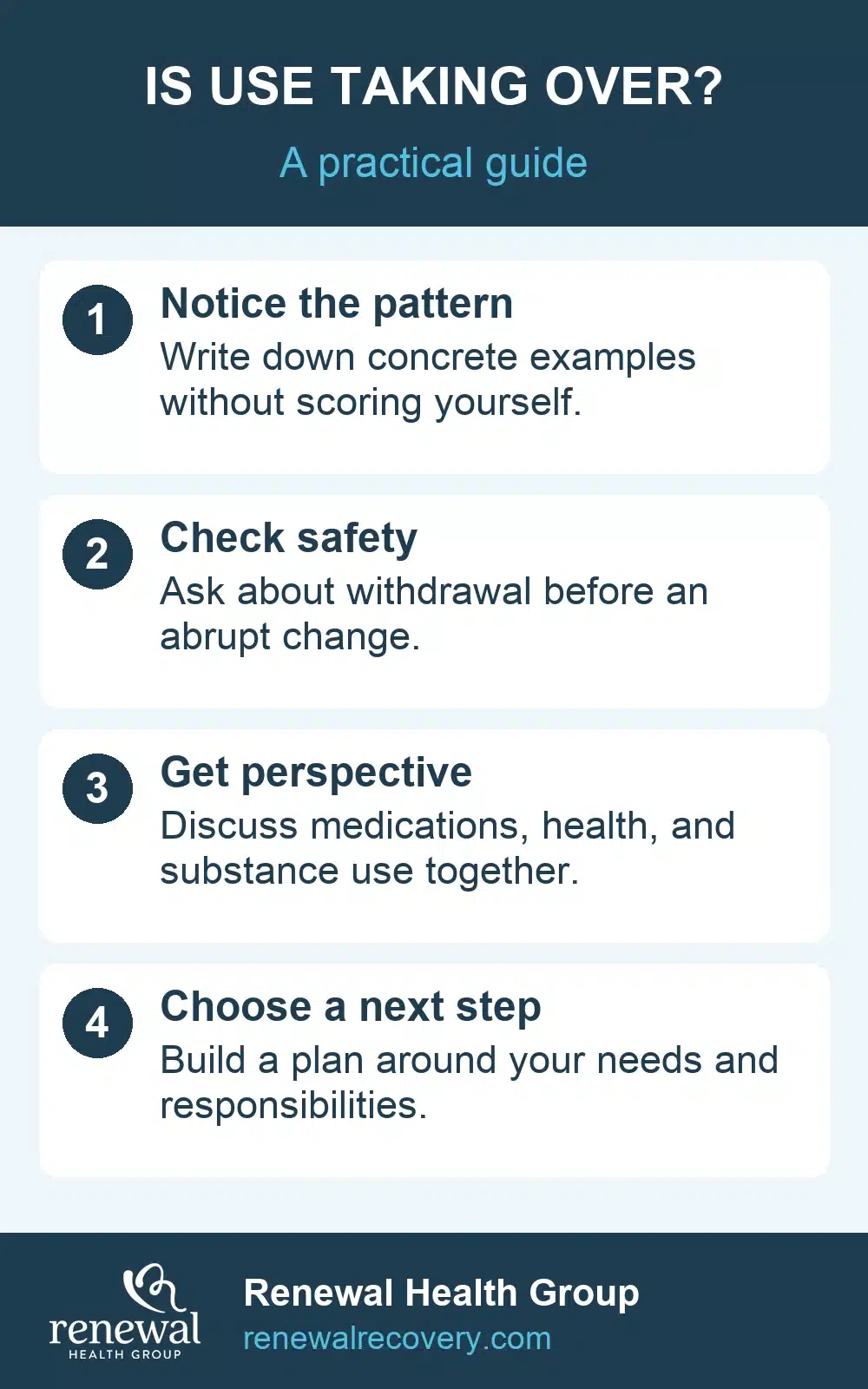
Bring three examples, your medication list, and a description of what you hope will improve. Ask about withdrawal safety, treatment options, and support that fits your responsibilities. You can say that you are unsure about stopping completely or uncertain whether treatment is needed. That uncertainty is a valid place to begin a clinical conversation.
Renewal Health Group’s admissions team can discuss assessment and care across its Southern California network. Call (818) 514-7355 to explain what has changed and ask about next steps. You do not need to wait until every part of life is disrupted. Getting a clearer picture now can help you make an informed decision about your health and support.
Frequently Asked Questions
Can I have a problem while still working?
Yes. Employment does not rule out a substance use disorder or the need for support. Assessment considers the broader pattern and its consequences.
Does this checklist diagnose addiction?
No. It is a reflection guide. A qualified professional can evaluate your history, symptoms, medications, and treatment needs.
Sources
- NIAAA: Alcohol Use Disorder—Risk, Diagnosis, and Recovery
- FDA: Benzodiazepine Safety and Withdrawal Warning
- CDC: Responding to a Suspected Overdose
- SAMHSA: What to Expect From Treatment

John Ingham is a nationally respected mental health and addiction recovery advocate with nearly a decade of professional and lived experience—from overcoming heroin and meth addiction to shaping public health policy alongside White House appointees, state legislators, and Nashville’s Ryan White Foundation. Based in Sparta, Tennessee, he has influenced landmark legislation (HB1486), lectured at UT Austin and Vanderbilt, appeared in an Emmy-winning documentary, and driven go-to-market strategies for behavioral health centers. A pioneer in telehealth and patient-centered care, John and his wife also steward a 7-acre homestead, and he looks forward to becoming a father in October 2025—all while building a legacy of truth, recovery, and community.
- John Ingham

- John Ingham
- John Ingham
- John Ingham
- John Ingham
- John Ingham
- John Ingham
- John Ingham
- John Ingham
- John Ingham


