

Key Points
- Many health plans cover substance use treatment, but the details depend on the plan.
- Network status, medical necessity, and authorization are separate questions.
- Benefits verification is not a guarantee of payment.
- Ask for written estimates and a clear process for appeals or coverage changes.
At a Glance
| Question | What to confirm |
|---|---|
| Which plan? | Exact policy and behavioral health administrator. |
| Which service? | Detox, residential, PHP, IOP, or outpatient. |
| Which provider? | Specific location and billing entity. |
| What approval? | Authorization requirements and review dates. |
| What cost? | Deductible, cost sharing, exclusions, and written estimate. |
| What if denied? | Written reason, deadline, and review options. |
An insurance card can open a path to treatment, but it rarely answers the questions families need answered before admission. Does the plan cover detox? Is the residential program in network? Will a separate clinician send another bill? When you are already worried about substance use, unfamiliar insurance language can make the process feel harder than it needs to be.
Start with a practical distinction: having a substance use treatment benefit is different from having a specific stay approved at a specific facility. This guide explains how to move from a general coverage question to a clearer understanding of your own plan. It is general information, not an individual coverage determination or a promise that an insurer will pay a particular claim.
Begin With the Exact Plan You Have
Use the member services number on your insurance card and ask which organization administers behavioral health benefits. Sometimes a separate company handles those benefits. Have your member identification available, but share it only through the insurer’s or provider’s secure process. Confirm the plan’s name, current enrollment status, and whether coverage will change soon because of employment, renewal, or another life event.
Two cards displaying the same insurance company name can represent very different networks and benefits. Ask for your Evidence of Coverage or Summary Plan Description, as appropriate. Identify who regulates the plan rather than assuming every policy follows the same California rules. Employer self-funded plans, state-regulated commercial coverage, Medicare, and Medi-Cal can involve different requirements and routes for help.
Understand the Role of California Coverage Protections
The California Department of Managed Health Care explains that state-regulated commercial plans must cover medically necessary mental health and substance use disorder treatment under California’s parity law. Federal parity rules also address how behavioral health benefits compare with medical and surgical benefits in plans to which those rules apply. These protections matter, but they do not make every provider or requested service automatically covered.
For your own decision, translate broad rights into specific questions. Which criteria will be used to review the recommended care? Is the provider in the plan’s network for that service? What is the process if an appropriate in-network service is unavailable? Ask the insurer to identify the relevant plan provision. A general statement that “rehab is covered” leaves too many practical details unresolved.
Match the Benefit to the Recommended Level of Care
Detoxification, residential treatment, partial hospitalization, intensive outpatient care, and standard outpatient visits are different services. Coverage for one does not settle coverage for another. An assessment should determine what care is clinically appropriate, while the benefits conversation clarifies how the plan treats that recommendation. Avoid choosing a setting solely because it appears easiest to authorize.
Ask whether the assessment, medication management, laboratory work, and follow-up appointments fall under the same benefit or separate billing arrangements. Renewal’s levels of care can help you organize the service names before calling. Use those names in the conversation, and request clarification when an insurer or program uses a different term for what seems to be the same service.
Confirm Network Status for the Specific Location
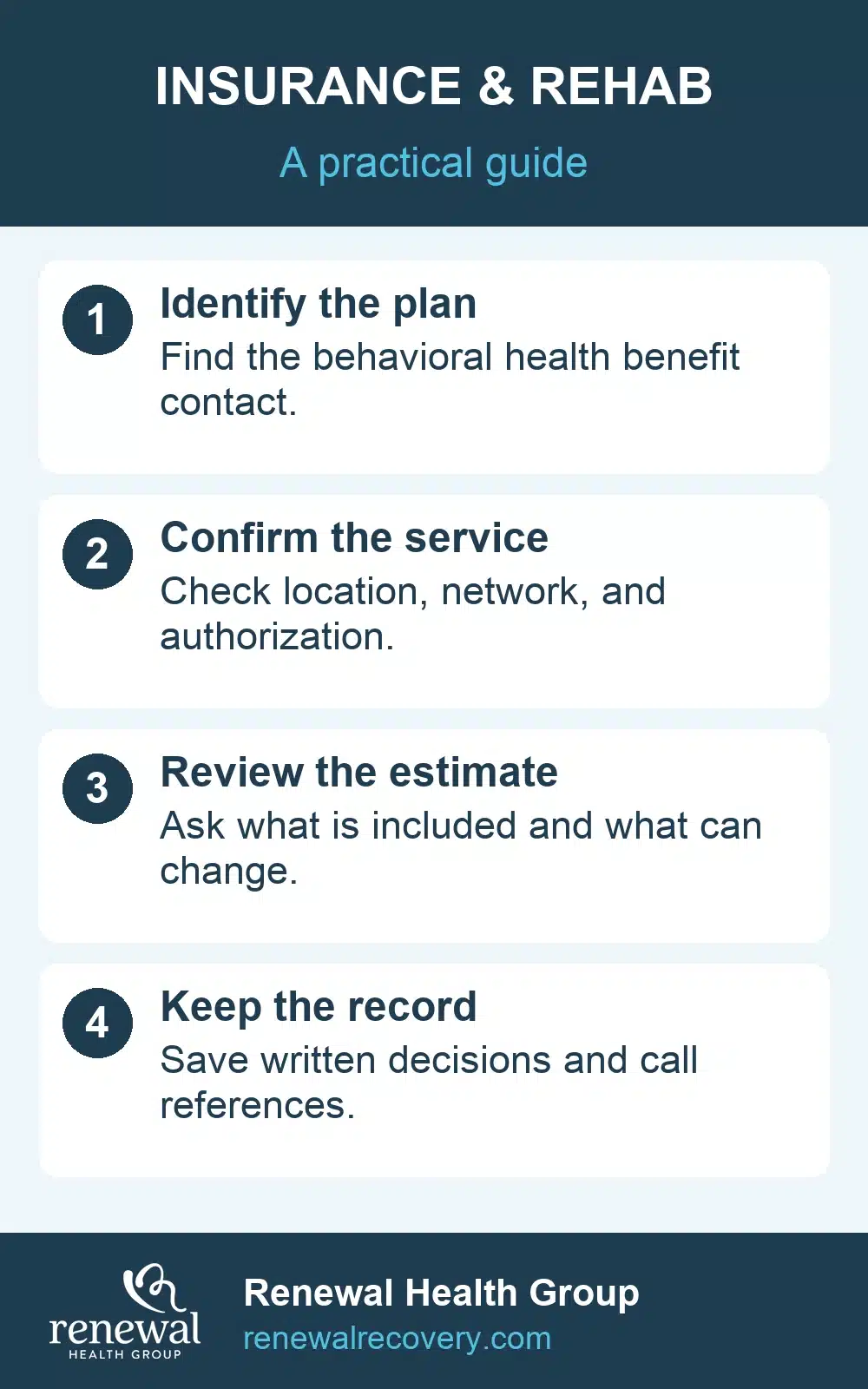
A provider may have several locations, legal entities, or program types. Ask about the exact facility and service being considered, not only the overall brand. Request the information the insurer needs to verify network participation, such as the billing entity and relevant provider identifier. Then confirm it with the insurer and note the date and representative’s reference number.
If care is out of network, ask whether the plan includes out-of-network benefits and how your financial responsibility would be calculated. A percentage alone is not enough if the plan uses an allowed amount that differs from the provider’s charge. Ask about possible balance billing and applicable protections. Get the answer in writing when possible, especially before committing to travel or a substantial payment.
Separate Benefits Verification From Authorization
Benefits verification checks information about a plan, such as active coverage and stated benefits. Authorization is a separate process through which an insurer may review a proposed service. Neither should be casually described as a guarantee that every future claim will be paid. Final payment can depend on eligibility, documentation, services actually provided, and other plan requirements.
Ask who submits authorization requests and whether approval is required before admission. Clarify the dates or services initially authorized and how additional care is reviewed. If the clinical team recommends a longer stay, find out how they communicate with the insurer and with you. A clear communication plan helps prevent surprises when a review decision changes the financial picture during treatment.
Build an Estimate You Can Understand
Request an explanation of your deductible, copayments, coinsurance, and remaining out-of-pocket maximum where applicable. Ask whether in-network and out-of-network amounts are tracked separately. Find out which charges count toward the limit and which might not. The remaining deductible is a starting point for the discussion, not necessarily the total amount you will owe.
A useful estimate identifies the services, expected dates, assumptions, and exclusions. Ask whether medications, professional evaluations, transportation, and other expenses are included. If a quote is based on an expected length of stay, ask how it changes if the clinical recommendation changes. Keep copies of estimates, authorizations, and financial agreements together so you can compare them with later explanations of benefits and bills.
Know What to Ask When Coverage Is Denied
A denial should lead to a request for the written reason and the relevant appeal instructions. Determine whether the issue concerns eligibility, missing information, network status, or medical necessity. Those are different problems with different possible responses. Ask the treatment team whether additional clinical documentation or a review conversation is appropriate.
Time limits matter. Ask the insurer about the deadline and whether an expedited review is available when waiting could seriously affect health. Depending on the plan and issue, an external review or regulator complaint may be available. DMHC provides help for plans it regulates; other plans may require a different agency. Seek qualified guidance for a disputed claim rather than relying on a general blog to resolve a specific legal question.
Consider Medi-Cal and Other Routes to Care
If commercial coverage is unavailable or unsuitable, ask about public treatment options. California’s county substance use access lines provide a route to information about local services. Ask about screening, eligibility, participating providers, and how to arrange an assessment. Do not assume that a private program accepts Medi-Cal simply because it operates in California.
The same care is needed when comparing Medicare or another specialized coverage arrangement. Confirm acceptance and the covered service directly. If you have more than one plan, ask how coordination of benefits works. A useful referral should help you understand the next contact and the information needed, rather than leaving you with a long list of organizations and no clear starting point.
Keep Treatment Planning and Financial Planning Connected
Families sometimes hesitate to ask financial questions because they fear appearing less committed to recovery. Clear cost information is part of making care workable. Choose one person to track insurance calls if the patient wants help, and ask what permission the insurer or provider needs before discussing protected information. Avoid sending sensitive documents through informal channels.
Revisit the plan before a transition between services. A move from residential care to outpatient care can involve a new authorization, provider, or cost-sharing arrangement. Confirm medication access and follow-up appointments as well as the next program’s fee. Continuity is easier when financial and clinical questions are addressed before discharge rather than during a gap in treatment.
A Short Call Can Produce a Clearer Next Step
Before ending a call, repeat what you understand: the service being considered, the network status, the authorization requirement, the estimated responsibility, and the person handling the next task. Ask the representative to correct anything inaccurate. Record the reference number and where written information will be available. This simple recap can reveal misunderstandings while the right person is still available to explain them.
If information conflicts, do not quietly choose the more reassuring answer. Ask the insurer and provider to clarify the specific discrepancy. A provider’s willingness to verify benefits is helpful, but it does not replace the plan’s own determination. The purpose is not to eliminate every uncertainty before seeking care; it is to identify which uncertainties affect your immediate decisions and who can resolve them.
Verify Benefits With Renewal Health Group
Renewal offers an insurance verification form and an admissions team that can discuss services within its Southern California network. Call (818) 514-7355 or contact Renewal to ask about the appropriate location, current availability, and the information needed for a benefits review. Request a clear explanation of any estimated cost and its assumptions. If someone is experiencing an overdose or another immediate medical emergency, call 911; emergency care should not wait for a routine benefits conversation.
Frequently Asked Questions
Does verification guarantee coverage?
No. Verification provides benefit information. Authorization, eligibility, clinical review, and claim requirements can still affect payment.
Will insurance cover every day of residential care?
That depends on the plan, medical necessity review, authorization, and other requirements. Ask how continuing care is reviewed and communicated.
Sources
- California DMHC: Behavioral Health Care
- California DHCS: County Substance Use Treatment Access Lines
- Renewal: Insurance Verification

John Ingham is a nationally respected mental health and addiction recovery advocate with nearly a decade of professional and lived experience—from overcoming heroin and meth addiction to shaping public health policy alongside White House appointees, state legislators, and Nashville’s Ryan White Foundation. Based in Sparta, Tennessee, he has influenced landmark legislation (HB1486), lectured at UT Austin and Vanderbilt, appeared in an Emmy-winning documentary, and driven go-to-market strategies for behavioral health centers. A pioneer in telehealth and patient-centered care, John and his wife also steward a 7-acre homestead, and he looks forward to becoming a father in October 2025—all while building a legacy of truth, recovery, and community.
- John Ingham

- John Ingham
- John Ingham
- John Ingham
- John Ingham
- John Ingham
- John Ingham
- John Ingham
- John Ingham
- John Ingham


